One of the UAE’s uppermost priorities has always been education. The UAE is one of the more established education markets in the area and remains a draw for investors, providers, and students.
The UAE has focused on educating both women and men. In the year 1975, the rate of adult literacy was 54% among men and 31% among women. Today, the literacy rates for both the genders are close to 95%. New initiatives have been established at all educational levels. A significant area of focus has been to transform K to 12 programs to guarantee that the UAE students are fully prepared to attend universities around the globe and compete in the global marketplace. In addition to this, some of the world’s best universities are making programs in the UAE, appealing talented students in the Arab world and worldwide.
The UAE’s obligation to education has helped the Emirates diversify its economy and prepared a new generation of young people ready to contest in the worldwide marketplace. In 2019, young people surveyed throughout the Arab world identified the UAE the top country to live in and to outdo for the eighth year running, reflecting the opportunities accessible to youth entering the workforce.
Education Ecosystem in the UAE
The education system in the UAE is divided into public schools, private schools and higher education. The Ministry of Education (MoE) oversees all the UAE-based education councils and authorities. The federal budget allocated for 2018 is $2.8 billion for General, Higher, and University Education Programs, which represents 20% of the total budget.
Key Education Trends
Few of the trends are mentioned as under –
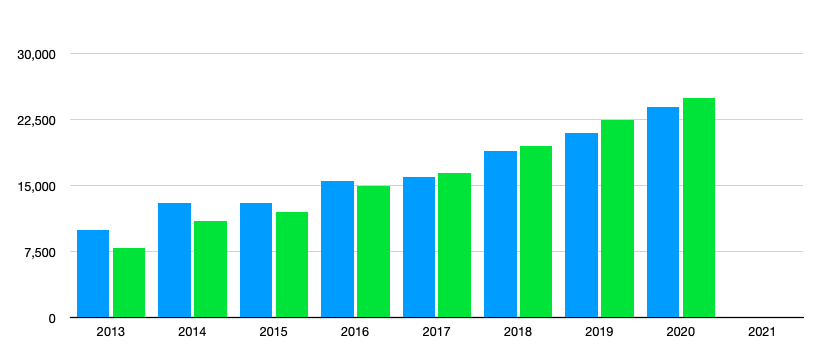
- Pre-K enrolment to increase in Abu Dhabi and Dubai, with the latter expected to grow at a faster rate. Here is a graph to help you understand.
- It is reportedly said that there is a shortage of quality schools in the fee range of AED 30,000- AED 50,000. Here is a graph to help you understand the private school distribution of size, curriculum, and rating in Dubai for the year 2017.
- Abu Dhabi and Dubai dominate with the highest number of education students, making private education a more striking option for students seeking quality international education. Here is a graph of higher education enrolment estimated by emirates and by sector.
Education as the National Priority for the UAE
The UAE’s Ministry of Education (MOE) developed the Education 2020 strategy, which is a series of ambitious five-year plans designated to bring significant qualitative improvement in the education system, especially in the way teachers teach and student learning. The strategy includes critical points like smart learning program, licensing and evaluation system, new teacher’s code, curriculum revision including teaching Math, English, and Science.
The Government of the UAE intensely supports education and learning facilities for students with special needs. Federal Law No. 29 of 2006, is the first law in the UAE to shield the rights of people with special needs.
Ministry of Education Strategy for 2017-2021
The UAE Ministry of Education launched a strategic plan for 2017 to 2021 to develop a pioneering education system for building an enlightened and internationally competitive society. The system will comprise of all age groups to be able to meet future labour market demand. It shall ensure the quality of the output of the Ministry of Education and provide the best facilities for internal and external consumers.
The new plan is built on the following values:
- Citizenship and Responsibility
- The Principles and Values of Islam
- Commitment and Transparency
- Equality and Justice
- Participation and Accountability
- Science, Technology and Innovation
-
Achievements of the UAE toward Quality Education
- Nearly 20% of the government’s budget is spent on developing the education system
- The government provides free education to the citizens of the UAE public school until higher education
- Presence of a wide range of highly accredited universities, both private and public
- Providing exclusive amenities for continuing education and accredited universities
- Operating private and public education school system offering over 16 curricula to serve different nationalities living in the UAE
- The illiteracy rate has been dropped to less than 1%
- Signing an agreement with software company Microsoft to follow best practices in education to back smart education programmes
-
As you can see, new initiatives have been launched; old have been achieved making the UAE a global marketplace for education.
We at Commitbiz are business setup consultants to help you register a business in the UAE. The educations sector is booming currently, as it is the time for the private sector to step into the rapidly growing environment. Should you decide to launch your business in the education sector, contact us, we’d be happy to help you.
Which are the best 7 locations for UAE Education businesses?
Freezones are always going to be the best suited for businesses in the education sector in UAE. The most sought-after free zones are -
- Dubai Knowledge Village
- Dubai Academic City
- Dubai International Academic City
- Western Educational Zone
- Abu Dhabi Educational Zone
- Sharjah Publishing City Free Zone
- Al-Ain Education Zone
What are the advantages of setting up a business in the Education Sector in UAE?
These are the benefits of doing business in the UAE Education Sector -
- UAE’s population is increasing at an astonishing pace as more & more immigrants are settling in UAE.
- UAE government is extensively investing in infrastructure, giving incentives & tax exemptions for non oil & petroleum businesses to thrive. UAE government officials know the importance of education, for becoming a global powerhouse. That’s why they’re putting extra efforts in developing this sector.
- UAE government has appointed regulatory bodies for streamlining the investment processes & operations for businesses.
- Multiple foreign investors are investing businesses in UAE, due its business potential.
- 100% Foreign Ownership
- Very Less Overheads
What documents are required for starting a UAE online education business?
These documents are needed for online education license UAE -
- Copy of your Passport
- Memorandum Of Association
- Visa
- ShareHolder certificate
- Freezone/ Mainland application form
- KHDA approval letter
- Tenancy contract of your office
What is the License cost for educational business in UAE?
For acquiring all your license & contracts you’ll have to pay approx AED 15000 ($ 4083.89) - 50000 ($ 13612.98)
Which are the Top 5 educational institutions in UAE in 2022?
- United Arab Emiraes University
- Khalifa University
- American University in Dubai
- Zayed University
- University Of Sharjah